


Forehead reduction surgery for men: is it right for you?

  • Blogs
  • Body

Authored and reviewed by Dr Duncan Brennand, Lead Aesthetic Doctor 

24 Sep 2026 | 101 Harley Street

For men considering forehead reduction surgery, the position of the hairline is only part of the picture. Just as important is whether that hairline is likely to stay where it is.

A naturally high, stable hairline can make someone a good candidate for surgery. An actively receding hairline requires more caution, as future hair loss could change the result over time.

At 101 Harley Street, we look at your hairline position, scalp laxity, hair density and likelihood of future recession before recommending treatment. Here, we explain what men considering forehead reduction need to know, from candidacy and scarring to the differences between surgery and a hair transplant. 

Book an Appointment

Who is forehead reduction surgery most suitable for?

Forehead reduction surgery can be a good option for men who have always had a naturally high forehead and would like to bring the hairline forwards.

Also known as hairline lowering surgery, the procedure involves advancing the hair-bearing scalp to create a lower frontal hairline and reduce forehead height.

For men, however, there is an additional factor to consider: male-pattern hair loss. If a lowered hairline subsequently begins to recede, this can change the appearance of the result and potentially make the incision more noticeable.

You may be a suitable candidate if you have:

  • A naturally high frontal hairline rather than an actively receding one
  • A hairline that has remained relatively stable over time
  • Good scalp laxity and mobility
  • Healthy hair density around and behind the hairline
  • Realistic expectations about how much your hairline can be lowered

Having some recession does not automatically rule out surgery. However, it makes a careful assessment of your current hairline and likely future hair loss particularly important.

In some cases, a hair transplant or another approach may be more appropriate. Your surgeon will discuss this with you during your consultation.

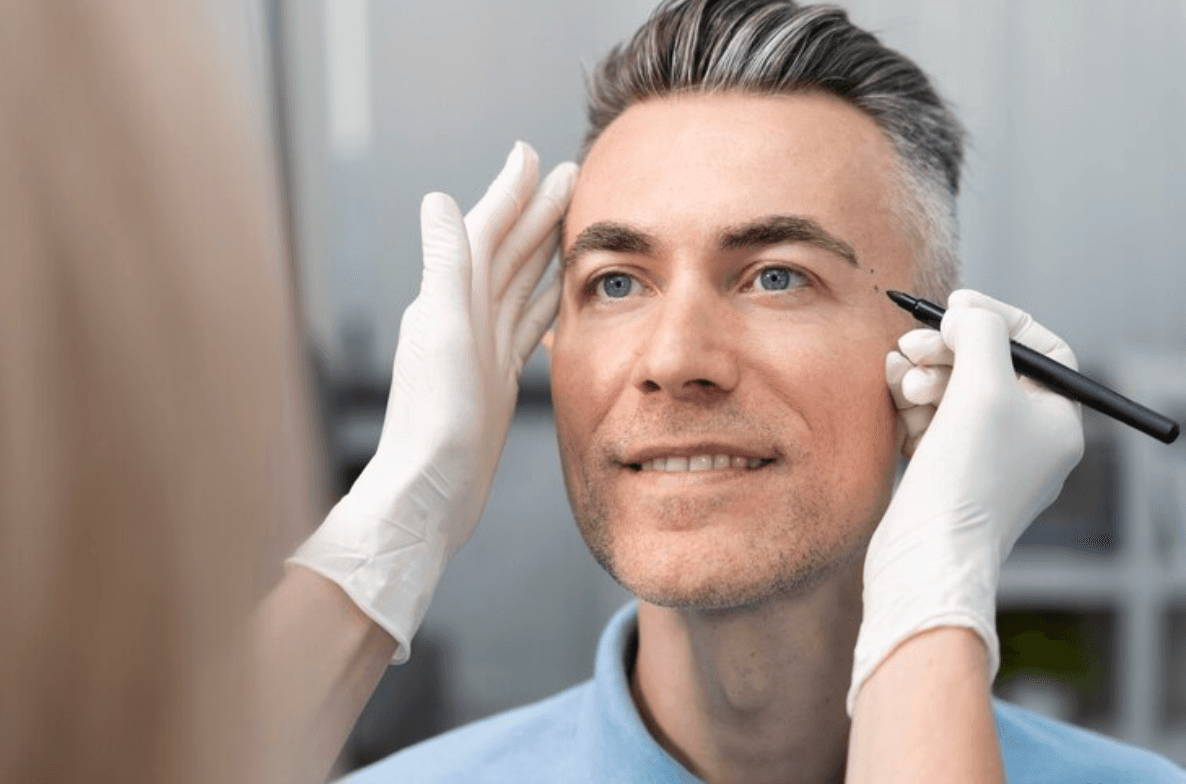
forehead-surgery-consultation

Why does hairline stability matter in male patients?

Forehead reduction moves your existing hairline forwards. What it cannot do is prevent that hairline from changing in the future.

This distinction is particularly important for men because androgenetic alopecia, or male-pattern hair loss, can continue to alter the frontal hairline over many years. If thinning or recession develops after forehead reduction, the position and appearance of the new hairline may change too.

Assessing suitability therefore involves looking beyond your forehead height. Your surgeon will also consider the shape of your hairline, any recession around the temples, the density of the frontal scalp and your history of hair loss.

Future hairline recession

Forehead reduction does not stop male-pattern hair loss. If you are already experiencing active recession, your hairline could therefore continue to move after surgery.

That does not mean every man with some degree of recession is automatically unsuitable. Instead, the likely stability of your hairline needs to form part of the decision.

If there is a significant risk of further hair loss, a more conservative approach or a different treatment may make more sense.

Learn More

A naturally high hairline vs a receding hairline

Naturally high hairlineReceding hairline

History

Has often been high since the teens or early adulthood

Has gradually moved backwards over time

Hairline shape

Tends to remain relatively consistent

May become more M-shaped as the temples recede

Hair density

Usually remains stable around the frontal hairline

Thinning may develop at or behind the hairline

Future change

Less likely to change significantly if genuinely stable

May continue to recede as male-pattern hair loss progresses

Forehead reduction

May be suitable if other factors, such as scalp laxity, are favourable

Requires careful assessment of future hair-loss risk

Hair transplant

May not be necessary where the existing hairline is healthy and stable

May be more appropriate where recession is the main concern

Learn more

How much can a man’s hairline be lowered with surgery?

There isn’t one standard amount that suits everyone. How far the hairline can be brought forwards depends largely on scalp laxity, or how easily the scalp can move. Someone with a naturally mobile scalp may have more scope for advancement than someone whose scalp is relatively tight.

Hair density matters too. Good density around the frontal hairline helps create a natural transition and can make the incision easier to disguise as it heals.

Then there are facial proportions. The aim of forehead reduction isn’t simply to create the lowest possible hairline. Its height and shape need to look balanced with the rest of your face.

Your surgeon can assess these factors during consultation and give you a realistic idea of what is achievable in your case.

What does scarring from forehead reduction surgery look like in men?

The incision for forehead reduction sits along the new hairline, at the border between the forehead and hair-bearing scalp. Careful incision planning helps the resulting scar blend into the hairline as it heals. Depending on the surgical technique used, a trichophytic approach may be used to help hair growth camouflage the incision.

Scar visibility is an especially important consideration for male patients because shorter hairstyles can leave the frontal hairline more exposed. With good hair density and careful incision placement, the scar is designed to become less conspicuous as it matures. However, a very short or closely clipped hairstyle may make the area more visible than a longer hairstyle would.

It is important to have realistic expectations. The aim is for the scar to fade and blend naturally into the hairline, rather than to promise that it will become completely invisible.

Hair growth around the scar

The incision sits along the new hairline, where the forehead meets the hair-bearing scalp. Its position is carefully planned so that it can blend into the hairline as it heals. A trichophytic incision may be used, which is designed to help hair growth camouflage the scar.

Scar visibility deserves particular consideration for men because shorter hairstyles tend to leave more of the hairline exposed. If you usually wear your hair very closely cropped, for example, the scar may be easier to see than it would be beneath longer hair. Hair density also makes a difference. Denser growth around the incision can provide more natural camouflage as the scar matures.

No surgical scar can be guaranteed to disappear completely. The aim is for it to soften and become less conspicuous with time, while sitting naturally within the hairline.

Forehead reduction surgery vs a hair transplant for men: which is best?

Forehead reduction and hair transplantation can both create a lower-looking hairline, but they do so in completely different ways. Forehead reduction brings the existing hair-bearing scalp forwards. It therefore tends to make most sense when the existing hairline is healthy and stable.

A hair transplant, by contrast, uses transplanted follicles to create or reshape a hairline. This can make it a more appropriate option for some men whose concern involves recession or an irregular hairline rather than a naturally high forehead.

Active hair loss can have a significant bearing on that decision, which is why it’s important to consider the two options in the context of your individual hairline rather than choosing on preference alone.

For a more detailed comparison, read our guide about forehead reduction versus hair transplant article.


Book a Consultation

What questions should you ask during a male forehead reduction consultation?

A consultation should leave you with a clear idea of whether forehead reduction makes sense for your hairline now and in the longer term.

Useful questions to ask include:

  • Is my hairline stable?
  • Would a hair transplant be more appropriate?
  • Is my scalp sufficiently mobile?
  • What hairline shape suits my face?
  • What is my future recession risk?

Your consultation at 101 Harley Street is an opportunity to assess these factors together and understand whether forehead reduction, hair transplantation or another approach is most appropriate for you.

Your surgeon can then explain the procedure, likely result and personalised treatment plan in more detail.

Frequently Asked Questions about Forehead Reduction Surgery

Can men have forehead reduction surgery?

Yes. Men can have forehead reduction surgery if they are suitable candidates. Important considerations include scalp laxity, hair density and whether the hairline is naturally high or actively receding. Male-pattern hair loss requires particular attention because future recession could affect the long-term appearance of a lowered hairline.

Can you have forehead reduction with a receding hairline?

It depends on the cause and extent of the recession. Where a hairline is actively receding because of male-pattern hair loss, a hair transplant may sometimes be more appropriate than surgical advancement. Your surgeon will assess your current hairline and future recession risk before recommending treatment.

Is forehead reduction different for men and women?

The surgical principles are similar, but candidacy and hairline planning can differ. Male patients require careful assessment of future hair-loss risk. Hairline shape and scar visibility may also need different consideration, particularly because many men choose to wear their hair relatively short.

How much can a male hairline be lowered?

The amount varies between patients and depends particularly on scalp laxity. Hair density, existing forehead height, hairline shape and facial proportions also influence what can be achieved. Your surgeon will assess your scalp during consultation before recommending a realistic degree of advancement.

Will my hairline keep receding after forehead reduction?

Forehead reduction surgery does not prevent male-pattern hair loss. If your hairline is susceptible to future recession, it could continue to change after surgery. Assessing hairline stability beforehand is therefore particularly important for male patients and may influence whether forehead reduction is recommended.

How can you find us?

Our surgery is located on Harley Street in Marylebone, London, within one of the world’s most prestigious and historic medical districts. Situated at 101 Harley Street, the clinic offers a discreet and refined setting in the heart of Central London, bringing together leading consultants, advanced facilities and personalised care.

We welcome patients from across the world, as well as patients travelling to London from across the UK and internationally for specialist medical, surgical and aesthetic treatments.

Our location benefits from excellent transport connections. Regent’s Park, Oxford Circus and Baker Street Underground stations are all within easy walking distance, while major London rail stations and international airports  including Heathrow, Gatwick and London City provide convenient access for national and international visitors.

Whether you are travelling from within London or further afield, our Harley Street clinic provides a calm, professional environment designed to deliver exceptional care in one of the capital’s most respected medical locations.

 

Opening hours
Monday
9 am–5 pm
Tuesday
9 am–5 pm
Wednesday
9 am–5 pm
Thursday
9 am–5 pm
Friday
9 am–5 pm
Saturday
9 am–5 pm
Sunday
Closed
101 Harley Street Day Surgery
101 Harley St, London W1G 6AH
Get directions
Speak to a specialist
Whatsapp